
Healthiest Cities in America (2026 Rankings) – WalletHub Study
Media Contact
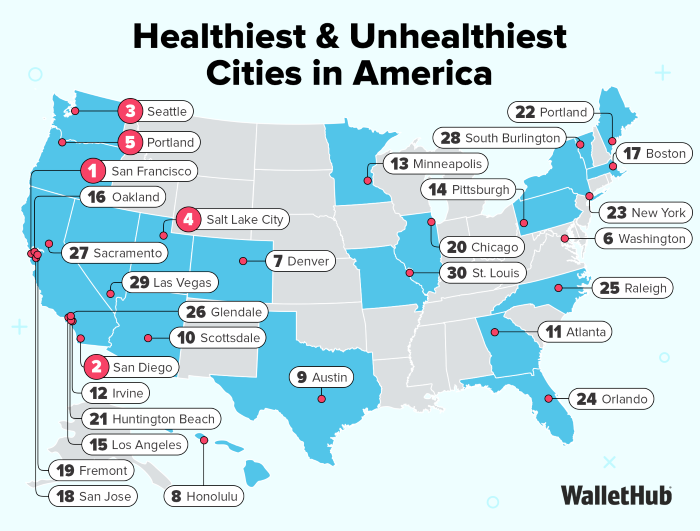
With more than 7 in 10 U.S. adults being overweight and health care costs rising, the personal-finance company WalletHub today released its report on 2026’s Healthiest Cities in America, as well as expert commentary, to show where people are saving and costing themselves the most money.
WalletHub compared more than 180 of the largest U.S. cities across 41 key metrics. The data set ranges from the cost of a medical visit to fruit and vegetable consumption to the share of physically active adults.
| Healthiest Cities | Unhealthiest Cities |
| 1. San Francisco, CA | 173. Memphis, TN |
| 2. San Diego, CA | 174. Montgomery, AL |
| 3. Seattle, WA | 175. Corpus Christi, TX |
| 4. Salt Lake City, UT | 176. Toledo, OH |
| 5. Portland, OR | 177. Huntington, WV |
| 6. Washington, DC | 178. Fort Smith, AR |
| 7. Denver, CO | 179. Shreveport, LA |
| 8. Honolulu, HI | 180. Laredo, TX |
| 9. Austin, TX | 181. Gulfport, MS |
| 10. Scottsdale, AZ | 182. Brownsville, TX |
Key Stats
- Overland Park, Kansas, has the lowest share of physically unhealthy adults, which is two times lower than in Huntington, West Virginia, the city with the highest.
- Augusta, Georgia, has the lowest cost per doctor’s visit, which is 2.9 times less expensive than in Juneau, Alaska, the city with the highest.
- Portland, Maine, has the lowest share of adults eating fruits less than once daily, which is 1.6 times lower than in Chattanooga, Tennessee, the city with the highest.
- Columbus, Georgia, has the lowest average monthly cost for a fitness-club membership, which is 15.7 times less expensive than in New York, the city with the highest.
To view the full report and your city’s rank, please visit:
https://wallethub.com/edu/healthiest-cities/31072
Key takeaways and WalletHub commentary are included below in text and video format. Feel free to use the provided content as is or edit the raw files as you see fit.
“Staying healthy is a personal responsibility, and everyone should strive to eat nutritious food, exercise regularly and look after their mental health. However, where people live can have a big influence on how successful they are at staying in good health, so the best cities are the ones that provide the greatest access to high-quality healthcare, green spaces, recreation centers, and healthy food.”
—
“San Francisco is the healthiest city in America, in part because it has the second-lowest share of obese adults in the country, at nearly 18% of the population. San Franciscans eat well and have good opportunities for exercise, too. San Francisco has the second-lowest share of people who eat less than one serving of fruits or vegetables per day, and 100% of the population lives reasonably close to a location where they can do some sort of physical activity.”
– Chip Lupo, WalletHub Analyst
Expert Commentary
What are the most important factors to consider in choosing a city that is good for your health?
“So many factors influence health, and when considering location, cost of living and income are critical components to consider. Access to healthy foods, and built environments that encourage and facilitate activity, are imperative for sustained health behaviors. Walkable neighborhoods, safe outdoor activities, and ample grocery stores increase the likelihood of healthy behaviors.”
Dara W. Ford, PhD, RDN, LDN – Professorial Lecturer, American University
“Do not just look at the hospitals. Look at what happens on a Saturday morning. Does the city have parks with actual fitness infrastructure and equipment? Look for pull-up bars, outdoor equipment, or open space designed for movement? Are there bike paths and walking trails people genuinely use? Can you find a community without it centering on food or drinks? Those are the signals that tell you whether a city treats health as a value or just a statistic. The best cities make staying active and connected easy, free, and part of everyday life, not something requiring scheduling or payment.”
Angeli Gianchandani – Adjunct Professor, NYU
“Cooking at home with staples like beans, grains, and vegetables improves diet quality without raising food costs. If possible, try to purchase often expensive foods like meat in bulk, then separate into smaller portions to freeze for later. Fruits and vegetables are great as canned, frozen, or fresh – get them how you can! Since protein foods tend to be the most costly, stretch your dollar by using less expensive options such as dried beans, nut butters, tofu, eggs, etc. Soups, stews, and mixed casserole-type dishes can be a great way to feed a crowd with less cost than meat main dish meals.”
Dr. Casey Colin, DCN, RDN, LDN, FAND – Associate Professor, University of North Florida
“It is possible to improve health on a budget. Walking is a wonderful form of exercise and can be included in short bursts if longer chunks of time are unavailable or unsustainable. Body weight exercises are also beneficial – think pushups and squats. In terms of nutrition, though food is quite expensive, there are some healthy low-cost options. Beans are a great source of fiber and protein and are low-cost. While fresh fruits and vegetables may be pricey, choosing canned or frozen versions without added sugar or salt is a wonderful choice to increase nutrients in the diet.”
Dara W. Ford, PhD, RDN, LDN – Professorial Lecturer, American University
What are some ways for local authorities to create healthier cities?
“Design cities for people, not just cars and commerce. The healthiest cities I have observed have three things in common: they have free, well-maintained public fitness infrastructure; they have programming that brings people together outside of eating and drinking; and they make daily movement the default, not the detour. That means investing in bolted outdoor equipment in parks, programming the plazas, protecting the bike paths, and making sure those investments exist across zip codes, not just in affluent neighborhoods. Health equity shows up in what you build and where you build it.”
Angeli Gianchandani – Adjunct Professor, NYU
“Healthier cities start with the basics: safe places to walk, bike, and get outside. When planners design neighborhoods, they should make sure sidewalks and trails actually connect people to the places they go every day, like grocery stores, schools, and parks. It sounds simple, but having a clear, safe way to walk from home to get fresh food or pick up a child from school makes a big difference in how people live. Some communities have built-in outdoor exercise equipment on their walking/biking trails which is an added bonus for those who don’t have to (or want to) pay for a gym membership. It also helps when a neighborhood has real food choices. Cities should think carefully about the mix of restaurants and grocery stores they allow to open, and work to prevent food deserts where families have to travel far for healthy options. When people can easily move around and have good food within reach, the whole community feels the benefit.”
Dr. Casey Colin, DCN, RDN, LDN, FAND – Associate Professor, University of North Florida
